


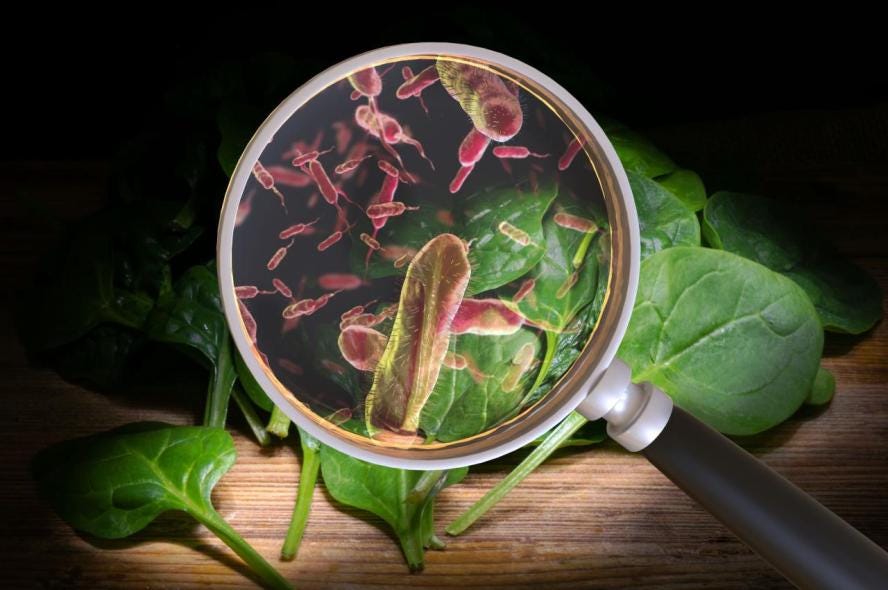
This past month, August 2026, a single head of lettuce sickened more than 11,000 Americans.
The Food and Drug Administration’s outbreak page put total number of people sickened by lettuce contaminated with Cyclospora at 11,458. The source of the outbreak was traced to Taylor Farms, a company based in Mexico. The CDC’s broader seasonal surveillance logged 18,445 confirmed domestic cyclosporiasis cases since May 1st alone. The tainted lettuce had already been shredded into salad kits and on the shelves at Walmart for weeks before the recall caught up. FDA inspectors did not show up to the Taylor Farms facility until almost one month after the recall went public.
That delay was no accident. It’s what happens when you strip a government agency down to bare-bones and still task it with protecting 340 million people’s dinner.
Here is the paradox that no one in the Trump administration or the Republican Party wants to talk about: the man running “Make America Healthy Again” has spent the last 18 months dismantling the machinery that keeps our food supply safe.
Ironically, this administration ran on a promise to clean up America’s food supply. Kennedy has built his entire public image around being healthy: exercise, eating “real food” and fewer chemicals. He has touted this philosophy as being key to ending the chronic disease epidemic in America. Meanwhile, the agency he runs has been gutted by Trump’s cuts and has allowed the calamity of illnesses to manifest over the last year and a half.
The Illness Timeline: A Year and a Half of Recalls
Foodborne illness has always existed. Salmonella, Listeria, and E. coli outbreaks happened under Joe Biden, under Trump’s first term, and under every administration before that. So, it’s not that this is a new phenomenon. We must look at what changed after January 2025though, to understand why this is happening.
Here’s a partial scoreboard of what Americans have been dealing with since the second Trump administration began:
2025:
Listeria, Fresh & Ready ready-to-eat foods. (10 illnesses, 1 death)
Salmonella Enteritidis, shell eggs. (two recalls and investigations)
Cyclospora, parsley. (69 illnesses)
Salmonella, spring mix. (40 illnesses)
Botulism, powdered infant formula. (recalled)
Salmonella, moringa-leaf powder. (recalled)
2026:
Salmonella Newport, cantaloupe. (70 illnesses)
E. coli O157:H7, raw cheddar cheese. (9 illnesses, recalled)
Listeria, ricotta cheese. (15 illnesses, 1 death)
Salmonella Enteritidis, shell eggs. (134 illnesses across 18 states, 1.5 million cartons recalled)
E. coli O145:H28, frozen blueberries. (17 illnesses; recalled Great Value Organic Triple Berry Blend sold at Walmart in 16 states)
Cyclospora, iceberg lettuce. (11,458 illnesses reported by FDA; ongoing investigation)
Salmonella Javiana, jalapeño peppers. (431 illnesses across 32 states, 57 hospitalizations; peppers traced to a Sinaloa, Mexico farm. Chipotle and QDOBA pulled them from their menus.
E. coli plus Salmonella Agona, alfalfa sprouts. (55 illnesses so far)
FDA food-enforcement actions (recalls, alerts, and adverse-event investigations) rose from 461 in 2024 to 575 in 2025. That is a 25% increase.
Supporters of the administration would say recalls alone don’t prove the food supply got more dangerous. They would say better detection could also be the reason for an increase in enforcement actions. But here’s the number that they cannot explain away: in 2024, the FDA successfully sourced about 77% of the outbreaks it investigated back to the producers of the food item.
In 2025, that percentage dropped to just 36%, more than a 50% decline. What has changed? The Doge cuts by Elon Musk’s motley crew and the firings by Trump; that’s what changed. There has been a deliberate erosion of our public health infrastructure; an infrastructure that used to catch problems within the food supply early. HHS Secretary Robert Kennedy, Jr. argues that America is suffering from a “childhood chronic disease epidemic” that is driven by ultra-processed foods and synthetic chemicals. He says we need to embrace a diet consisting of whole, farm-grown ingredients.
I don’t disagree with that assertion. Nutrition scientists have long touted the healing effects of a diet rich in whole foods as a cure to the myriad chronic illnesses plaguing the American populous. Kennedy is not wrong in championing a whole food diet. The problem is his department is touting consumption of healthy whole foods while simultaneously gutting the apparatus that makes sure farm-sourced food is safe to eat.
Kennedy has been especially vocal about raw, unpasteurized milk. He has publicly expressed support for the raw milk movement and reportedly has a raw milk company executive advising the FDA. Consuming raw milk puts you at a well-documented, elevated risk of Salmonella, Listeria, and E. coli. Yes! The very same pathogens listed in the above outbreak list. Kennedy has now gone quiet on raw milk consumption. I guess because the political backlash got too high once the outbreak numbers started to increase.
It seems everyone Trump taps for these important posts are just like him: totally inept when it comes to sound policy ideas and management. It’s a pattern we see repeating itself throughout this administration: bold rhetoric about purity and root causes, paired with a consistent thread of deregulation everywhere the actual inspection and enforcement apparatus is concerned.
What Actually Happened Inside the FDA
This is the part that tends to get lost in the back and forth of politics. So, I’ll be precise:
In the spring of 2025, HHS announced it was eliminating 10,000 jobs department-wide, on top of another 10,000 employees who had already departed through buyouts and early retirement offers. This reduced the ranks of HHS from roughly 82,000 employees to about 62,000 (NPR, Reuters). Within the FDA specifically, the April 2025 restructuring targeted 3,500 positions (HHS Fact Sheet). Office of Personnel Management data shows that the FDA lost 3,859 employees in 2025 and another 473 through early 2026. That is 4,332 employees gone, out of an agency that employed about 16,000 - 18,000 people before the cuts began (FoodNavigator).
When you add the cuts to the USDA, the total reduction in staff increases. The USDA lost nearly 20,000 staffers in fiscal year 2025 alone, with cuts hitting the Food Safety and Inspection Service and the Animal and Plant Health Inspection Service. That’s the agency responsible for catching livestock disease outbreaks like bird flu (Food Safety Magazine). Adding FDA and USDA food-safety losses togethergives you the 11,000 combined FDA and USDA food-safety positions cut. That is a 22% reduction in the workforce tasked with keeping contaminated food out of the supply chain.
The Trump administration has repeatedly insisted that food inspectors were protected from direct layoffs. And, technically, that is true. But it’s the entire support system that got hollowed out; and that support system is what allows FDA and USDA to be effective.
More staggering numbers as evidence:
89 staffers from the FDA’s Human Foods Program were fired in February 2025. These employees were responsible for covering nutrition, infant formula safety, and chemical safety review.
Most of the staff who arranged inspectors’ travel were eliminated, leaving inspectors to book their own logistics. This translated into fewer inspections being completed.
The FDA’s entire media and communications team was fired. This made it impossible for the agency to get recall information to the public in a timely manner. (Food Safety News)
The CDC’s FoodNet active surveillance system, which tracks major foodborne pathogens including Cyclospora, was scaled back in August 2025 due to funding cuts.
The FDA’s latest budget called for placing the responsibility of routine inspections onto already cash-strapped states. It would result in a 7.6% staffing cut to the Human Foods Program and a 54.4% reduction to Field Laboratory Operations — the labs that test contaminated samples (Food Safety News).
The inspection numbers offer clear evidence of the cost of all the cuts. Foreign human-food inspections — covering imported food, which makes up about 20% of everything Americans eat — fell from 805 in fiscal 2024, to 723 in fiscal 2025, to just 214 in the first two quarters of fiscal 2026. Foreign food-facility inspections overall are down nearly 35% since a 2019 peak of 1,700 inspections (Fortune, Federal News Network).
The sycophantic supporters of this administration and indeed most Republicans in Congress would dismiss this article as a partisan attack. But the numbers do not lie. It is the policy decisions of this administration, the staffing cuts, the budget proposals, the disbanded support systems, that decimated the infrastructure meant to catch contamination before it spreads.
How to Protect Yourself and Your Family Right Now
As news of the outbreaks continued to fill our TV screens, a lot of us have been more than a little nervous while shopping for groceries. We don’t need to panic, but we do need to be a bit more deliberate than we used to be. Here’s what you can do:
Don’t wait to hear about a recall from friends or from the news. FoodSafety.gov has alerts you can subscribe to and you can follow FDA and USDA recall notices.
Wash fresh produce under running water; even pre-washed bagged salad greens. Cook meat, poultry, and eggs to safe internal temperatures. Refrigerate leftovers promptly. Keep raw meat separate from ready-to-eat food. Sanitize cutting boards between uses (CDC).
Be extra cautious with the categories driving this year’s outbreaks: leafy greens and pre-cut/bagged produce, sprouts, unpasteurized milk and juice, soft cheeses, and imported produce.
Know your household’s risk level. Pregnant people, young children, older adults, and anyone immunocompromised should be especially careful because these groups face the highest risk of severe complications.
Report it if you get sick. Food born illness is chronically underreported. In a system that’s been hollowed out, your report might be one of the few signals that identifies growing outbreak sooner.
Lastly, find out how your representatives voted on agency funding and hold them accountable. If they didn’t vote to fund the agency that keeps our food supply safe, vote them out.
A video discussion of this topic can be viewed on our Substack page and on YouTube.