



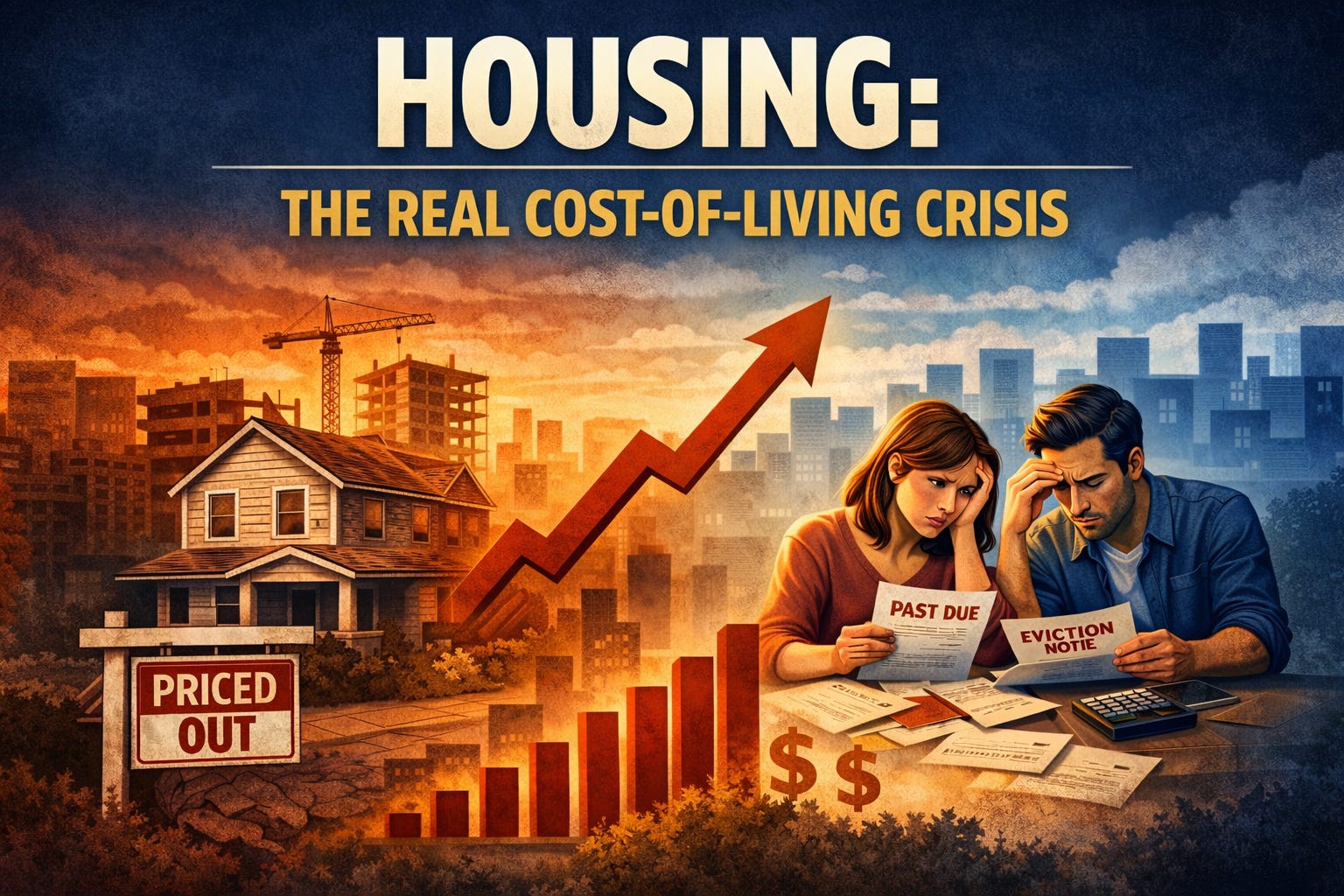
If prices aren’t going back down, then the next question is obvious: Where is the pressure really coming from?
Well, high grocery and gas prices are the easy-to-identify culprits of tighter budgets. These realities are in our faces daily as we go about our lives. But, they aren’t what’s really driving the cost-of-living crisis. Housing is.
And to understand why everything feels so damned expensive even as we are hit with a barrage of “inflation has slowed” – from news pundits, politicians, and the President – you have to start with housing.
The Expense That Dominates Everything Else
For most Americans, housing is the largest expense in their budget. Do you know anyone who has a monthly cost higher than the cost of their housing? According to the Bureau of Labor Statistics, housing accounts for roughly one-third of total consumer spending, making it the single biggest category in household budgets.
The scale of this matters:
A modest increase in food prices is noticeable.
An increase in rent or mortgage payments reshapes a person’s entire budget.
And that’s why cost-of-living pressure feels persistent—even when inflation slows.
Housing is a Totally Different Animal
Housing doesn’t respond to economic shifts the way other goods do.
The production of consumer goods can be increased quickly. But increasing the housing supply is a slow and constrained process.
Construction takes years
Land is limited in high-demand areas
Local regulations restrict development
The result is a structural imbalance.
According to Freddie Mac, the U.S. housing market is estimated to have a shortage of several million homes. The shortage has built up over a period of more than ten years. When the available supply of an in-demand product is constrained in this way, rising demand leads to sustained price increases.
The Policy Constraint
Market forces are not the only factor affecting housing – it is heavily affected by policy. Zoning laws, permitting rules, and density restrictions determine how much housing can be built and where.
Research from institutions like the National Bureau of Economic Research has shown that restrictive zoning in high-demand areas significantly limits supply and leads to price increases.
In many cases, these policies have had a simple but direct effect:
Fewer homes built
Higher prices
Reduced affordability
Why It Doesn’t Get Fixed
So, you may ask, if the problem is so clear, why does it persist? It persists because of misaligned incentives.
· Rising home values benefit existing homeowners
· New development often faces local opposition
· Elected officials respond to those pressures.
This creates a system where the status quo—limited supply and higher prices—is easier to maintain than to change.
Interest Rates Made It Worse
Recent interest rate increases have added another layer.
Higher rates have:
· Increased mortgage costs
· Reduced affordability for buyers
· Discouraged current homeowners from selling
Many homeowners are locked into low mortgage rates from previous years and are unwilling to move, which further limits supply.
The result is a tighter market with fewer available homes and continued upward price pressure.
Even if other prices stabilize, housing keeps overall costs elevated. This is why many of us feel that affordability hasn’t improved, even as inflation data shows moderation. But people don’t live in “data”. They live in reality: with real dollars, trying to pay real mortgages, rents, and household bills.
When housing expense rises, it defines the experience of the economy.
The Reality
If prices aren’t going back down, housing is the clearest example of why.
It is constrained.
It is policy driven.
And it is resistant to short-term change.
Which also means:
If there is any place where the cost of living can meaningfully improve, this is it.
Not quickly.
Not easily.
But structurally.
Because while many prices are shaped globally, housing is shaped locally—and that makes it one of the few areas where change is actually possible.