



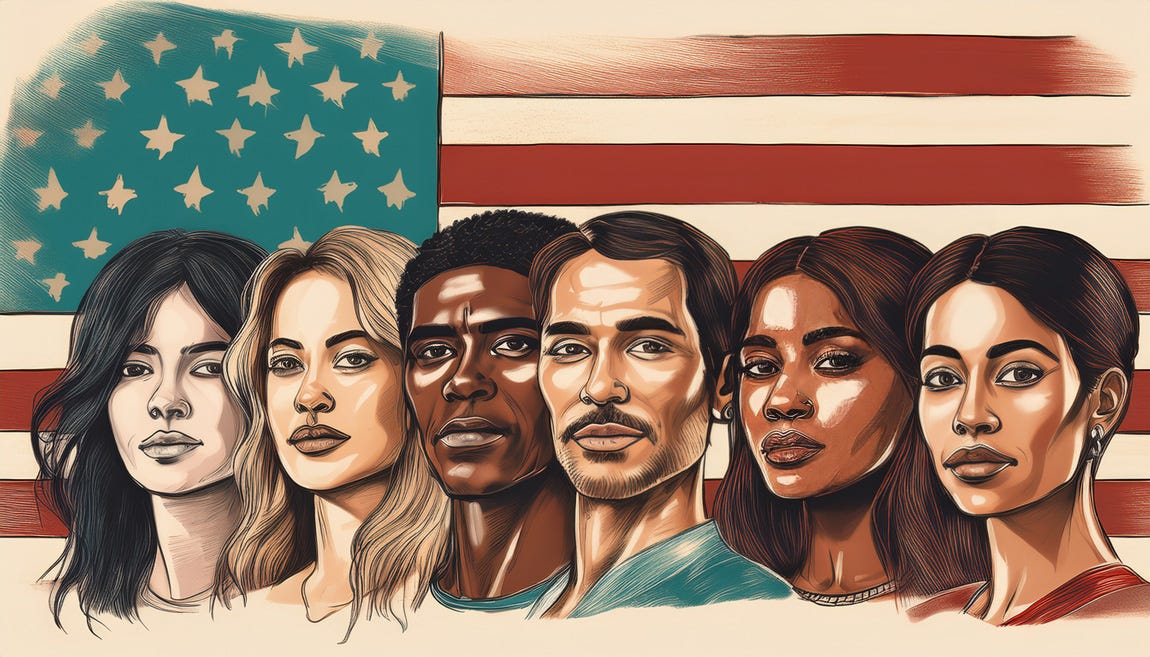
As debates rage across the United States over birthright citizenship, a sobering and vital question emerges: If being born here doesn't make you American, then who does it make you? And more provocatively: If birthright citizenship isn't valid for some, is it truly valid for anyone?
The Challenge to the 14th Amendment
The 14th Amendment to the U.S. Constitution, ratified in 1868, granted citizenship to "all persons born or naturalized in the United States." Its purpose was to ensure formerly enslaved people were legally recognized as Americans. But today, political movements and figures—including within the Trump Administration—have challenged this right.
This isn’t just a debate over law. It's a battle over identity, belonging, and power. Challenging the right of children born to undocumented immigrants to be U.S. citizens may seem like a narrow legal issue, but it opens a profound philosophical trap.

A Trap of Contradictions
Applying the logic of anti-birthright crusaders leads to unsettling conclusions. If people whose ancestors arrived recently, or without paperwork, are not "real" Americans—what then of white Americans, many of whom descend from immigrants who came in eras with far looser entry requirements, often without documentation?
The Native Paradox
Native Americans lived here for millennia before 1776, yet they were not granted U.S. citizenship until 1924. That means the only truly indigenous group to this land had to petition for recognition under the very nation built on their dispossession.
"It is a bitter irony that the descendants of the original inhabitants of this land were the last to be granted the citizenship that others now seek to deny others."
If birthright citizenship is invalid for some, it becomes arbitrary, subjective, and ultimately, revocable by political whim. A dangerous road.
The Racial Double Standard
Let's name the truth: many of those who oppose birthright citizenship aren't talking about European immigrants. They’re not targeting the descendants of Italian, Irish, or German immigrants. Instead, the scrutiny falls disproportionately on children of Latino, African, Asian, and Middle Eastern descent.
This double standard reveals the true aim—exclusion based on ethnicity and race, not legal consistency.
A Threat to All
Dismantling birthright citizenship undermines a foundational principle of American democracy: that everyone born on U.S. soil is equally American, regardless of heritage. If that principle becomes negotiable:
Citizenship becomes conditional based on things like race, class, or ideology
Rights become revocable
Future generations could be rendered stateless
What happens to the descendants of enslaved African Americans if the 14th Amendment is hollowed out? Could a future court rule that their generational claim to citizenship is also invalid, since their ancestors were brought here involuntarily? It may sound extreme, but legal precedent is shaped by slippery slopes.
And what of the descendants of Chinese, Irish, or Jewish immigrants—groups once despised, now woven into the fabric of American identity? The threat posed by ending birthright citizenship is not limited to any one group. It endangers the very definition of who we are.
Who Gets to Be American?
If the standard is ancestral legitimacy, then only Native Americans truly qualify. Everyone else—white, Black, Asian, Latino—is here because of migration, forced or voluntary. The entire American experiment rests on the idea that being here, being born here, or becoming naturalized here is enough.
To challenge that idea is to challenge the glue that holds the nation together.
Final Thought
If birthright isn’t valid for some, it isn’t valid for anyone. Citizenship cannot be a prize awarded by ideology. It must remain a promise guaranteed by principle.
In a time of rising exclusion and narrowing definitions of who belongs, defending birthright citizenship is more than legal advocacy—it is a stand for a democratic and inclusive America.
Want more articles like this? Subscribe to Pragmotiv Plus to read more bold, thoughtful commentary on society, culture, and the big questions that shape us.