


These articles examine documented conflicts of interest, foreign-influence concerns, self-dealing allegations, and alleged politicization of government power. They do not assert that every action constitutes a proven crime or a criminal quid pro quo. The central question is whether the pattern is compatible with accountable, impartial government. The first installment discusses the family’s cryptocurrency ventures, money moving through Trump properties, and a Russian Oligarch’s role in Donald Trump Jr.’s wedding; all of which raise the same question: who can buy access to the White House
Roughly twenty months into Trump’s second presidential term and my head spins when I try to recall all the allegations of unconstitutional, unethical, illegal, and downright cruel actions by his administration.
Critics, political opponents and ethics professionals have accused the administration of running a pay-to-play operation that leveragespublic office for private enrichment.
His administration is doing so much so fast that I believe we, the people, are too busy trying to keep food on the table and gas in our cars to keep the multiple corruption allegations in our collective memories.
So, we decided to chronicle them here on our Substack and let readers take a comprehensive look at the slush funds, foreign deals, shady gifts, and pay-to-play allegations thus far.

Photo credit: Bloomberg.com
A Cryptocurrency Presidency
Donald Trump made a lot of promises during his third run for the office of President of the United States. He promised he would cut energy prices in half within 12-18 months. Specifically, he said he would drive the national average gasoline price to below $2 a gallon.He also promised to bring down the cost of groceries, housing, electricity, car insurance, interest rates and prescription drugs. He promised he would put the American people’s interest above those of the powerful elite, but gas is now more than $4 per gallon because of his War in Iran. Interest rates are up, and the price of food continues to rise.
Rather than concentrating on fulfilling those promises, it seems he and his family have concentrated on themselves. He and his family now hold significant assets gained since his return to office in January 2025. It’s nothing new for a president or his family to hold assets. What is new is how much of the Trump family’s business interests overlap with areas directly affected by the federal government: cryptocurrency, international finance, real estate, trade, technology, defense, and foreign policy
This overlap created a serious public interest problem. Can Americans trust that their current president will make fair and impartial decisions when those affected by his decisions might also be in business with the president’s family, friends, or close allies?
World Liberty Financial is the Trump family’s cryptocurrency venture. The nature of crypto makes political and financial influence difficult to track. Unlike the traditional banking system, which has robust systems for identity verification, crypto transactions are pseudonymous; meaning, transactions are tied to alphanumeric wallet addresses on a public blockchain. Influencers or political actors can control dozens of these wallets without their identity being linked to them.
When funds move through the traditional banking system, it is tracked through robust Know Your Customer (KYC) protocols and legally mandated reporting of suspicious activity. Not so with crypto transactions which are often person-to-person and happen on decentralized exchanges that aren’t required to have mandatory identity verification and suspicious activity reporting. There are also tools that allow users to pool funds, scramble them, and distribute them to new wallets, making it virtually impossible to track the source.
This makes cryptocurrency the perfect business for those trying to peddle influence and pay-to-play. Could Barack Obama’s brother-in-law have had a cryptocurrency business and Obama not have been harshly scrutinized, investigated, and possibly impeached? At the very least, the White House ethics counsel would have recommended divestment.
Reuters has reported that the Trump family received more than $800 million from the sale of crypto assets during the first half of 2025. Trumps own financial disclosures report more than $1 billion in income from the crypto ventures, including hundreds of millions from World Liberty Financial and Trump’s meme coins.
This asset class and how it is transacted is not transparent and can be used by private entities, sovereign-linked funds, and wealthyforeign nationals to do business with the president’s family. It not necessary for a foreign government to sign a direct deal with the Trump Organization for influence to be peddled. The question that should be considered is whether a president can make decisions involving financial regulation, foreign governments, trade, defense, technology, or law enforcement when the people affected by those decisions may be enriching his family.

Photo Credit: Trump.com
Funneling Taxpayer Funds to Trump Properties
A more familiar version of this same conflict involves the Trump family’s real estate and hospitality business. There are major costs involved in getting a president from point A to point B. There’s Secret Service protection, lodging, military support, staffing, communications, local law enforcement coordination, catering and events operations. Here is where there is a direct conflict-of-interest concern over government or political money possibly flowing into Trump-owned properties. Official activity taking place at a property owned by the president means government spending is now revenue for a private business connected to the president.
Mar-a-Lago and Trump Tower have all hosted official activity. Mar-a-Lago has hosted fundraisers for the Republican Party and other conservative groups. Reuters estimated possible revenue of more than $20 million in 2024 alone.
Here are three potential streams of revenue:
Tax dollars spent for official travel, protection, or events
Political spending from campaigns, PACs, party committees, and conservative organizations
Private spending by those seeking proximity to Trump or his advisers. Think donors, foreign officials, lobbyists, corporations and special interest groups.
It’s not that spending is illegal, per se. It is, however, a private entity benefitting from public office. And it can all be substantiated by documentation like invoices, procurement records, Secret Service expenditure reports, campaign-finance filings, event contracts, andproperty records. Investigators should follow the money and identify what policy interest, if any, was affected by the transaction.
We are not saying a president should not visit a property he or she owns, but an owner being a public official transforms the property into somewhere people may decide to spend money there because they believe they can curry favor or purchase access.
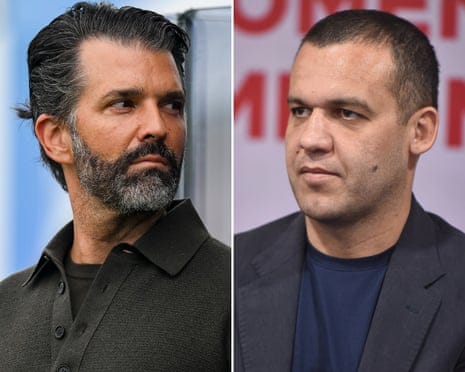
Photo Credit: The Guardian
The Oligarch-Funded Wedding
When Trump’s eldest son Don Jr. got married to Bettina Anderson in May 2026, the festivities were held in the Bahamas and partially funded by a man named Umar Kremlev. Kremlev is a Russian businessman who leads the International Boxing Association. The AP reports that he is a Russian oligarch with close ties to Putin, but the couple describe him as a “dear friend” who generously hosted two nights of celebration after their nuptials. It’s been reported that Kremlev paid for the private island where the reception was held, paid for a spectacular fireworks show, and had his staff assist with planning.
Kremlev’s proximity to Putin brings up obvious scrutiny as to what this could mean at a time when the United States government is making decisions that affect Russia, Ukraine, economic sanctions, and trade. Trump has repeatedly attacked his opponents over alleged foreign influence. The relentless pursuit of Hunter Biden and his laptop is what should come to mind.
Apparently, the pressure is being felt by Trump because he has made a public statement saying Don Jr. would repay Kremlev. Although there has not been any disclosure on the amount, manner or timing of such a payment.
There is no evidence that Kremlev received anything in return for his generosity. But each of these scenarios illustrates the same danger. Private money can enter the president’s family orbit while the federal government makes decisions worth billions of dollars to people, corporations, and foreign governments that may be seeking influence.