



We need Wall Street to Wall Street, and we need Main Street to Main Street. We, the everyday citizens, need to spend money at stores so businesses can invest, banks can lend, and the economy can grow. Everything—from tech to real estate—depends on that cycle.
So, we all know what everyone’s been talking about: Donald Trump’s tariffs. People from all sides of the political spectrum have weighed in on the debate—will they spark economic growth, or send us spiraling into a downturn not seen since the Great Depression—or, let’s be real, maybe even worse?
One thing that seems to define today’s political climate is the acceptance of nonfactual information, gaslighting about what’s really happening, and a shocking level of ignorance about how the house of cards we call our beloved society actually works.
We all know how bullish Donald Trump has been on tariffs. His love affair with tariffs showed up during his first term before his 2020 loss to Joe Biden. Now that he’s back, he’s decided to go all in—doubling down on policies that most economists say are “detrimental to the economic welfare of the United States and the global economy.”
So Why Has Trump Backed Down Lately?
Well, it might have something to do with the U.S. bond market.
If you’re like most people reading this, you're probably thinking, “This is way over my head... why should I care about the stock market, the bond market, etc. when I’m just trying to make it to payday and keep food on the table?” I hear you. But that line of thinking is exactly what’s gotten us into the mess we’re in. Everything is connected. The entire system relies on everyone playing their part to keep things running.
We need Wall Street to Wall Street, and we need Main Street to Main Street. We, the everyday citizens, need to spend money at stores so businesses can invest, banks can lend, and the economy can grow. Everything—from tech to real estate—depends on that cycle.
But when you throw a wrench in the system, which Trump’s tariffs have done, you risk crashing the whole thing. Think of it like a virus infecting your computer: maybe you can fix it... if the damage isn’t too deep. But let’s be honest, it’s probably never going to work the same again. And unlike a computer, we can’t just go out and buy a new country.
A large part of what makes the United States a global leader and a superpower is, let’s be frank—our money. America without money cannot lead the world.
According to NBC News’ article “How Trump Changed His Mind on Tariffs,” :
"Ahead of Trump's announcement, some of his advisers had been in a near panic about the bond markets, according to a senior administration official. Interest rates on 10-year Treasury bonds had been rising, contrary to what normally happens when stock prices fall and investors seek safety in treasuries. The unusual dynamic meant that at the same time the tariffs could push up prices, people would be paying more to buy homes or pay off credit card debt because of higher interest rates. Businesses looking to expand would pay more for new loans."
Why is this bad?
Because we were on the brink of collapse. Had Trump continued down this path against the advice of his own advisers—which, let’s be honest, he’s done before—this is the chain reaction that could’ve unfolded:
Trump’s Aggressive Tariff Policy Backfires
The U.S. imposes sweeping tariffs on major trading partners: China, Canada, the European Union, and Mexico. In retaliation, these countries fire back with their own tariffs—launching a full-scale global trade war.
Inflation Surges
With inflation already high from pandemic-era disruptions, the tariffs raise the cost of imported goods—everything from electronics to raw materials. Domestic producers, facing less foreign competition, raise prices too. Inflation spikes far beyond the Federal Reserve’s target.
Federal Reserve Response
The Federal Reserve—a quasi-governmental but independent body—reacts by sharply raising interest rates to fight inflation. That means higher costs for mortgages, car loans, credit cards, and business loans. Economic growth slows, tipping the U.S. into a recession.
Foreign Investors Lose Confidence
Major foreign holders of U.S. Treasury bonds—like China and Japan—see the trade war and inflation surge as signs of instability. They begin dumping U.S. bonds, fearing losses and unpredictability.
Bond Market Panic
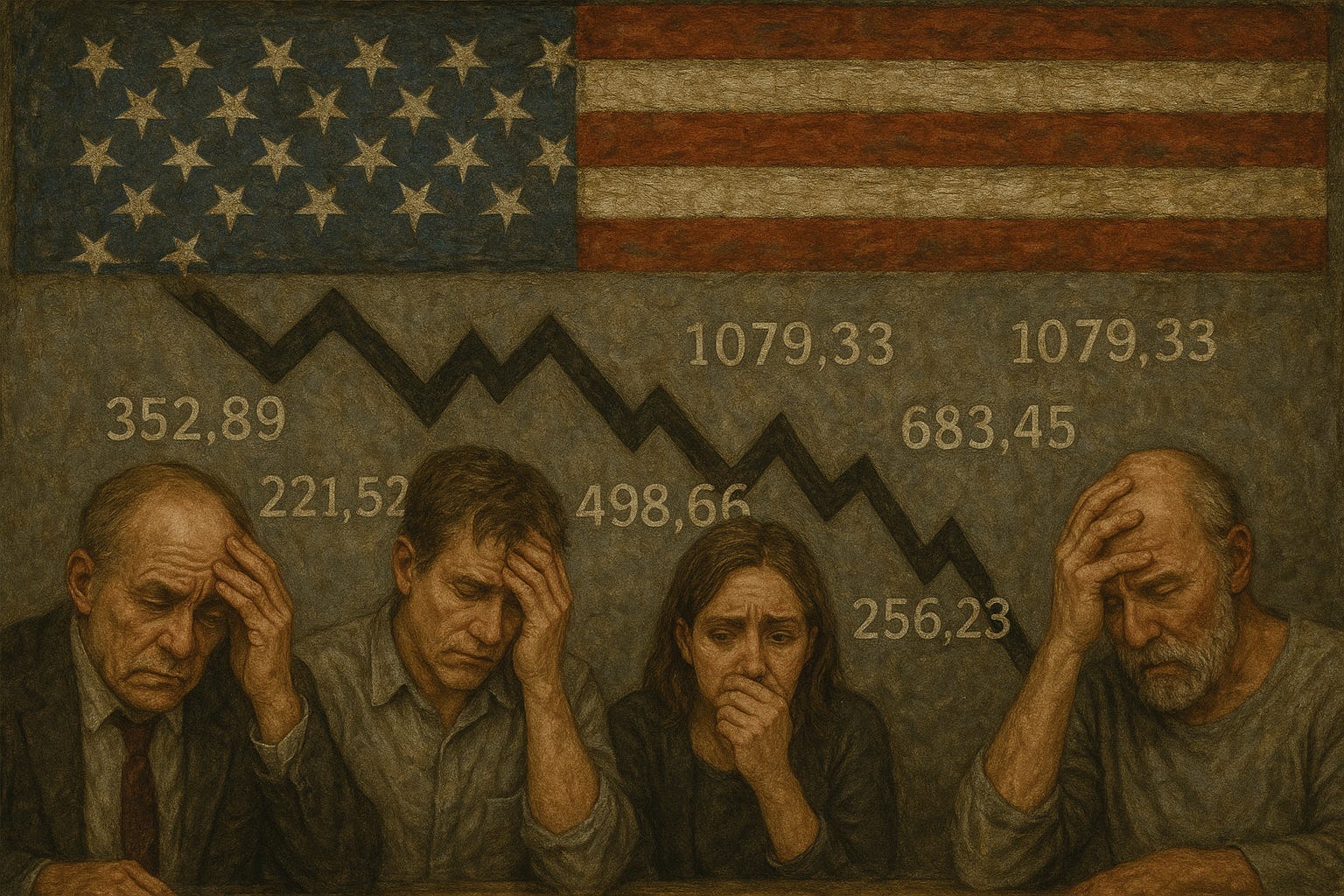
As foreign holders sell off Treasuries, bond prices crash and yields spike. Domestic investors follow suit. The U.S. government struggles to attract buyers for new debt without offering significantly higher interest—ballooning America’s debt servicing costs.
Sovereign Debt Crisis
With sky-high yields and fewer buyers, the U.S. struggles to refinance trillions in debt. Credit rating agencies downgrade U.S. bonds, further scaring off investors. Confidence in U.S. economy and its leadership erodes rapidly.
Economic Spiral
The collapsing bond market destabilizes banks and financial institutions holding U.S. debt. Lending dries up. The dollar weakens dramatically. Inflation gets worse. The stock market crashes. Unemployment soars as companies shed workers in panic.
Political and Social Fallout
With economic chaos and political dysfunction at a peak, polarization worsens. Civil unrest spreads. The federal government considers extreme emergency measures like:
Capital controls (limiting money flowing in/out of the country)
Austerity measures (cutting government spending, which means public services will be cut, and taxes would be raised)
America already runs a $2 trillion annual deficit—this scenario would likely blow that number up. The United States' global influence? Virtually gone.
This entire scenario, in theory, could take just months to unfold. All it would take is a sustained combination of economic missteps, global retaliation, and a collapse of investor confidence.
It may sound extreme—but it’s very possible.
This is why competence matters. This is why elections matter. Yes, it might be inconvenient to wait in line to vote or have that tough conversation with a relative who thinks their vote doesn’t matter—but what’s more inconvenient? That… or mass layoffs and a collapse of the country as we know it?
We have to remember to keep things in perspective. No, the United States isn’t perfect—far from it. But things can always get worse. The goal should be to maintain and improve our system, not tear it down and hope we can fix it later. That’s not how you run a lemonade stand—let alone the most powerful country in the world.